Case Studies
Agentic AI Call Center Financial Transformation for St Luke's Hospital

Client Background
St Luke’s Hospital operates within a large-scale patient access environment where inbound communication volume remains a defining operational characteristic. The organization manages approximately 400,000 patient interactions each month across prescription requests, appointment scheduling coordination, and complex clinical consultation workflows. Patient access functions represent a critical operational gateway influencing care delivery timelines, patient satisfaction metrics, and administrative cost performance.
Existing service delivery infrastructure depended heavily on manual call center intervention. Frontline agents, triage nurses, and administrative personnel collectively supported inbound demand through labor-intensive workflows. Leadership teams observed increasing financial pressure as demand growth continued without corresponding gains in workforce productivity or process automation maturity. Administrative staffing levels expanded to maintain service standards, creating structural exposure to escalating operating expense trajectories.
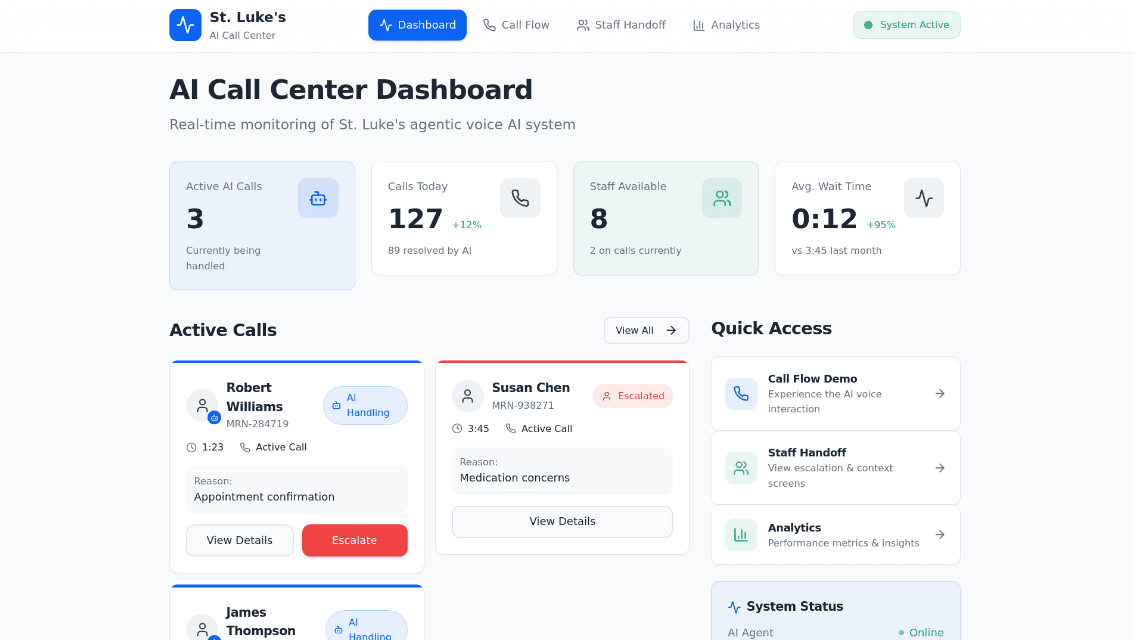
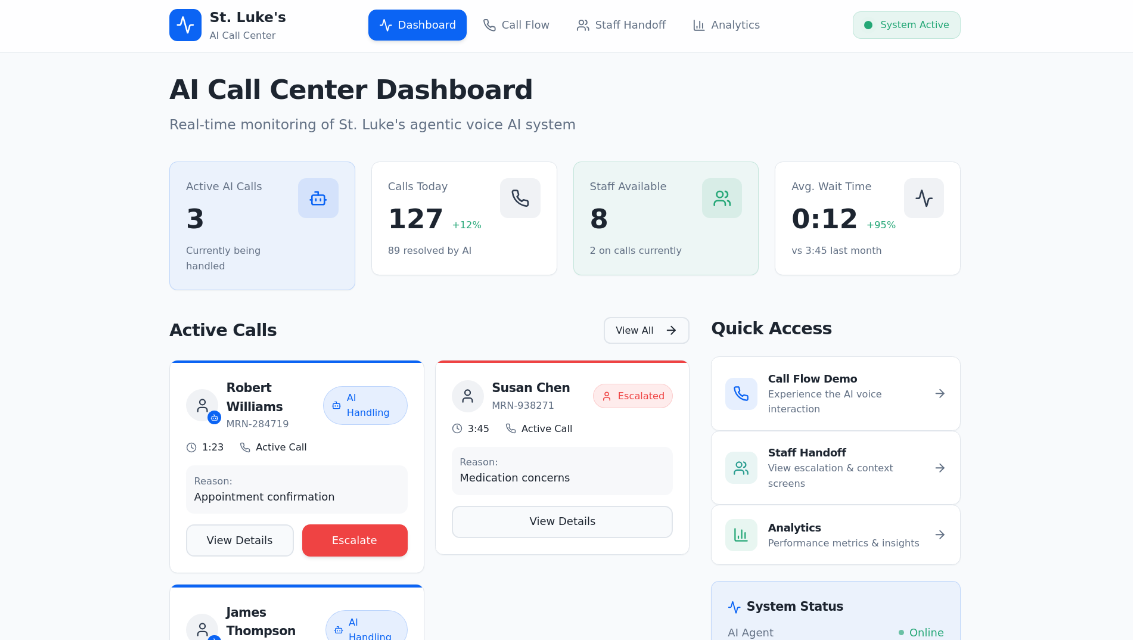
Strategic leadership engagement with NextGen Coding Company focused on evaluating a digitally enabled operating model capable of preserving care quality while improving financial resilience. The engagement centered on quantifying enterprise-scale economic impact associated with deployment of an Agentic AI call center platform designed to automate routine interactions, accelerate complex clinical workflows, and introduce data-driven operational efficiency.
The Problem
Patient access operations demonstrated a direct cost dependency tied to workforce headcount. Full human handling of monthly interaction volume generated approximately 100,000 labor hours based on a pre-implementation average handle time of fifteen minutes per call. Workforce productivity assumptions indicated a requirement of roughly 781 full-time equivalent agents operating at an eighty percent utilization level across standard monthly scheduling cycles.
Administrative verification processes, prescription routing steps, scheduling triage activities, and documentation responsibilities consumed substantial portions of agent capacity. Call transfer frequency across departments further extended interaction duration and fragmented the patient communication journey. Clinical staff including triage nurses were routinely assigned clerical responsibilities, reducing available time for direct medical assessment and intervention.
Financial exposure linked to existing workflows exceeded three and a half million dollars per month in direct labor expenditure. Annual patient access workforce costs approached forty-three million dollars. Continued interaction growth threatened to compound financial strain, limiting the organization’s ability to allocate capital toward clinical innovation initiatives and long-term service modernization priorities.
Employee experience indicators also reflected systemic stress associated with repetitive administrative engagement. Workforce fatigue risks increased as service queues lengthened and call complexity diversified. Patient experience outcomes were similarly affected, with prolonged hold times and delayed resolution for routine administrative requests.
Our Solution
NextGen designed a comprehensive Agentic AI call center transformation framework centered on workflow automation, clinical interaction acceleration, and financial efficiency optimization. The architecture targeted steady-state automation performance within a sixty-five to seventy percent resolution range following phased adoption and operational tuning.
Routine patient requests such as prescription refill coordination and appointment scheduling represented primary automation opportunities. Autonomous conversational agents were configured to manage eligibility verification, pharmacy confirmation steps, and scheduling triage pathways without human intervention. Automated intake functionality reduced manual data capture requirements, lowering average handle duration for remaining human-assisted calls by approximately one and a half minutes.
Through elimination of repetitive administrative touchpoints, the platform enabled scalable interaction handling capacity while maintaining continuity of patient communication standards. Automation coverage significantly reduced call transfer frequency, streamlining patient journeys and improving service responsiveness.
Clinical Context Acceleration
For complex consultation interactions requiring medical judgment, the system introduced structured pre-engagement data capture. Symptom narratives, historical context indicators, and severity markers were gathered prior to clinician connection. Interaction summaries were presented at the start of each consultation, allowing physicians and nurses to focus on diagnostic reasoning rather than preliminary information gathering.
Clinical workforce productivity improved as high-cost providers entered conversations equipped with actionable context. Triage staff transitioned toward direct patient care responsibilities, strengthening alignment between professional expertise and operational workload distribution.
Headcount Optimization and Financial Efficiency
Automation-enabled interaction deflection reduced required staffing levels from approximately 781 agents to nearly 211 agents under steady-state conditions. Monthly workforce expenditure declined from roughly $3.57 million to approximately $965,536. Projected monthly labor savings exceeded $2.6 million, representing annual gross efficiency gains above $31 million.
Infrastructure operating costs associated with the AI platform were modeled near $212,250 per month. Even after accounting for such expenditure, projected net annual financial benefit remained above $28 million. Long-term projections suggested cumulative ten-year economic impact exceeding $287 million, enabling sustained reinvestment into clinical programs and strategic patient service initiatives.
Cloud-Based Conversational Intelligence Platform
The proposed environment leveraged enterprise cloud services supporting real-time transcription, conversational automation, and advanced interaction analytics. Core components included AWS Transcribe for speech-to-text processing, Amazon Polly for neural voice response generation, Amazon Lex for conversational intent orchestration, and Amazon Connect AI functionality enabling self-service routing and sentiment analysis insights.
Operational modeling assumed transcription demand near 4.4 million interaction minutes monthly alongside extensive conversational request processing volume. Storage lifecycle governance incorporated intelligent tiering strategies supporting compliance retention objectives while balancing infrastructure cost efficiency.
Average AI interaction handling cost was estimated near $0.51 per call across automated and assisted workflows, aligning with established enterprise conversational automation benchmarks.
Adoption Ramp Strategy
Implementation planning incorporated phased deployment designed to ensure workforce alignment and governance readiness. Initial pilot periods focused on conservative automation thresholds and staff onboarding initiatives. Progressive expansion across scheduling and prescription workflows enabled gradual efficiency realization while maintaining service continuity.
Optimization cycles targeted improvements in intent classification precision, duplicate request detection logic, and escalation calibration. Financial benefits were expected to compound as operational maturity increased and automation coverage expanded toward steady-state performance levels.
Results
Steady-state transformation projections indicated significant restructuring of patient access economics. Monthly human-handled interaction volume declined from approximately 400,000 calls to roughly 120,000 calls. Corresponding labor hours decreased from 100,000 hours per month to nearly 27,000 hours.
Workforce headcount requirements were reduced by more than seventy percent, enabling concentration of human expertise on high-value medical consultations and complex service resolution scenarios. Monthly labor savings exceeded $2.6 million, translating into gross annual efficiency gains above $31 million.
Cloud platform operating expenditure remained modest relative to realized workforce savings. Monthly infrastructure cost levels near $212,250 represented less than ten percent of labor reduction impact, enabling rapid return on investment realization.
Scenario modeling provided additional executive planning visibility. Conservative adoption pathways indicated automation stabilization near fifty percent interaction coverage. Upside performance scenarios projected automation potential approaching eighty percent interaction resolution with expanded workflow integration.
Operational benefits extended beyond financial performance indicators. Reduced administrative workload contributed to improved employee engagement metrics and lower burnout exposure. Structured interaction routing and automated verification processes supported enhanced patient satisfaction outcomes and faster resolution timelines.
Why It Matters
Healthcare service delivery increasingly requires digital operating models capable of addressing administrative complexity without compromising clinical governance standards. Patient access represents a foundational interaction channel shaping institutional perception, care timeliness, and long-term patient loyalty outcomes.
Agentic AI call center architecture introduces a scalable mechanism for decoupling interaction growth from staffing expansion. Financial flexibility generated through automation enables executive leadership to reallocate capital toward clinical innovation programs, infrastructure modernization initiatives, and population health strategy development.
Workforce experience implications remain equally significant. Reduction of repetitive clerical workload supports an environment where clinicians and support personnel concentrate on judgment-driven responsibilities aligned with professional expertise. Such alignment strengthens talent retention potential and reinforces organizational culture focused on meaningful patient impact.
Enterprise-wide data intelligence capabilities introduced through conversational analytics infrastructure provide actionable insights extending beyond call center operations. Predictive staffing models, workflow performance indicators, and real-time interaction quality monitoring contribute to continuous improvement across broader care delivery ecosystems.
Call To Action
NextGen Coding Company designs resilient infrastructure that protects mission-critical communication at scale.
Contact admin@nextgencodingcompany.com or book a call to speak with our solutions team to begin scopinghttps://calendly.com/next_gen_coding_company/30min
Let’s Connect
At NextGen Coding Company, we’re ready to help you bring your digital projects to life with cutting-edge technology solutions. Whether you need assistance with AI, machine learning, blockchain, or automation, our team is here to guide you. Schedule a free consultation today and discover how we can help you transform your business for the future. Let’s start building something extraordinary together!