Case Studies
Email Infrastructure Architecture for Reliable, High-Volume Delivery

Client Background
FileForms operates a compliance-focused digital platform supporting businesses with filing requirements across multiple jurisdictions. The platform sends hundreds of thousands of emails daily, many tied directly to time-sensitive regulatory actions, payments, and account access.
Email functions as a core operational dependency rather than a secondary communication channel. Filing confirmations, payment receipts, authentication links, and account invitations represent mission-critical messages that users expect to receive immediately and reliably. Failure to deliver any of those communications directly impacts customer trust, support volume, and service credibility.
As platform usage and geographic reach expanded, email volume increased significantly, introducing new technical and reputational risks. FileForms required an email delivery architecture capable of supporting scale while protecting critical communications from disruption caused by promotional traffic, regional spikes, or third-party tooling.
NextGen Coding Company was engaged to document, validate, and formalize an email infrastructure strategy designed to ensure long-term deliverability, resilience, and operational control.
The Problem
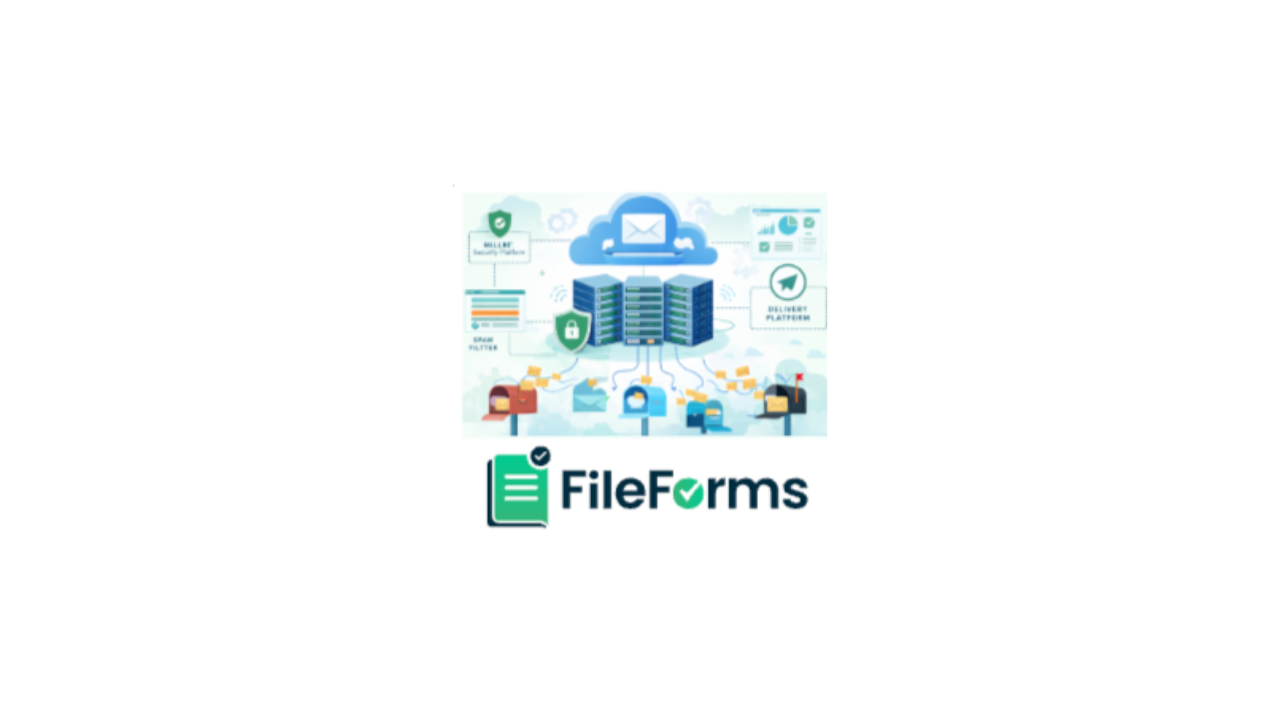
Email delivery at scale presents challenges that extend beyond sending volume. Internet service providers and mailbox providers evaluate every message based on sender reputation, engagement patterns, and historical behavior. When critical and non-critical messages share infrastructure, negative signals from promotional campaigns can degrade delivery for transactional emails.
FileForms faced several intertwined risks:
- High daily email volume tied to compliance activity
- Distinct engagement patterns between transactional and marketing emails
- Geographic concentration of filings in certain regions
- Use of third-party marketing tools with separate sending behavior
- Increasing reliance on inbox placement for core service delivery
A single misconfigured campaign, spike in spam complaints, or reputation issue could jeopardize delivery across the entire platform if infrastructure lacked isolation. The challenge involved designing an architecture that separated risk, preserved brand reputation, and supported continued growth without sacrificing reliability.
Our Solution
NextGen’s Solution began with formal classification of all outbound email traffic based on purpose, urgency, and expected engagement. Email streams were divided into two primary categories, each treated as a distinct operational workload.
Transactional emails included time-sensitive, customer-initiated messages:
- Authentication magic links
- Payment receipts
- Filing confirmations
- Account invitations
Marketing emails included informational and promotional communications:
- Annual report reminders
- Filing deadline notifications
- Newsletters
- Re-engagement campaigns
Separating email streams allowed infrastructure decisions to reflect real-world expectations. Transactional messages required maximum deliverability consistency, while marketing messages tolerated greater variability in engagement and filtering.
Domain and Subdomain Architecture
Email identity was structured around controlled use of domains and subdomains to balance brand continuity with reputation isolation.
The primary root domain handled transactional traffic, reinforcing trust and consistency for essential communications. Dedicated subdomains supported marketing streams, each aligned with a specific message category such as notifications or reminders.
This approach delivered two strategic benefits:
- Protection: Deliverability issues affecting one subdomain remained contained, preventing spillover into other streams
- Clarity: Recipients could identify email intent immediately, supporting engagement expectations
Subdomains functioned as independent reputation containers while remaining visibly connected to the FileForms brand.
Dedicated IP Strategy
Email delivery relies not only on domains but also on the IP addresses responsible for sending messages. FileForms implemented a fully dedicated IP model, eliminating reliance on shared infrastructure.
Dedicated IP addresses provided full ownership over sending reputation, enabling precise control over volume, cadence, and recovery strategies. Responsibility for reputation management remained internal, aligning accountability with operational impact.
Each IP address served a defined purpose:
- One IP exclusively for transactional emails
- Separate IPs assigned to specific marketing streams
Such separation ensured negative signals from one stream could not immediately affect others.
IP Pools for Scale and Resilience
NextGen’s Solution organized IP addresses into logical IP pools, each mapped to a functional purpose. Pools allowed dynamic routing of traffic without architectural changes.
Defined pools included:
- Transactional pool dedicated to critical business messages
- Multiple marketing pools aligned with campaign type or volume
When sending emails, the system specified the appropriate pool, ensuring messages originated from infrastructure matching their risk profile.
If a marketing pool encountered reputation challenges, traffic could be rerouted instantly to alternate pools while remediation occurred. Transactional delivery continued uninterrupted.
Reputation Management Framework
Email reputation operates across two interdependent layers: IP reputation and domain reputation. FileForms designed infrastructure with both dimensions in mind.
IP reputation reflected behavior tied to a specific server address:
- Spam complaint rates
- Bounce rates
- Sending volume patterns
- Blacklist exposure
IP reputation changed quickly, allowing recovery within weeks through disciplined sending behavior.
Domain reputation reflected long-term brand trust:
- Engagement metrics such as opens and clicks
- Authentication records including SPF, DKIM, and DMARC
- Historical sending consistency across providers
Domain reputation persisted across providers and IPs, making protection critical.
Coordinated Reputation Isolation
The architecture aligned IP and domain strategy to protect both short-term deliverability and long-term brand trust.
When an email was sent:
- Receiving servers evaluated IP reputation for immediate trust
- Receiving servers evaluated domain reputation for brand legitimacy
Both signals needed positive standing for optimal inbox placement.
Multiple subdomains paired with multiple IPs created layered isolation:
- Each subdomain built an independent, portable reputation
- Each IP provided immediate containment when issues arose
A marketing campaign generating spam complaints affected only the associated IP and subdomain. Transactional infrastructure remained unaffected.
Regional and Third-Party Isolation
FileForms expanded the architecture further to address operational realities.
High-volume regions such as Florida operated on dedicated infrastructure, preventing regional spikes from influencing broader sending behavior. Filing activity in one jurisdiction could not degrade delivery elsewhere.
Third-party marketing tools used by internal teams sent through a completely separate subdomain and IP on a different root domain. External tool behavior never intersected with core FileForms reputation assets.
Results
The implemented architecture delivered measurable operational benefits without altering user-facing functionality.
Key outcomes included:
- Consistent delivery of time-sensitive transactional emails
- Isolation of marketing-related reputation risk
- Rapid mitigation paths during deliverability incidents
- Scalable capacity for increased email volume
- Preservation of long-term domain reputation
Critical communications such as filing confirmations and payment receipts maintained inbox placement even during high-volume marketing periods or regional filing surges.
The system provided flexibility to expand IP pools, introduce new subdomains, and support growth without architectural redesign.
Why It Matters
Email deliverability directly impacts customer trust and service reliability. For compliance-driven platforms, a missed confirmation or delayed receipt undermines the core value proposition.
Proper email infrastructure transforms deliverability from a reactive concern into a controlled operational asset. Isolation, redundancy, and reputation management protect both customers and brand credibility.
Invisible to end users, email architecture determines whether critical interactions succeed or fail. FileForms’ approach ensures reliability scales alongside business growth rather than becoming a constraint.
Call To Action
NextGen Coding Company designs resilient infrastructure that protects mission-critical communication at scale.
Contact admin@nextgencodingcompany.com or book a call to speak with our solutions team to begin scopinghttps://calendly.com/next_gen_coding_company/30min
Let’s Connect
At NextGen Coding Company, we’re ready to help you bring your digital projects to life with cutting-edge technology solutions. Whether you need assistance with AI, machine learning, blockchain, or automation, our team is here to guide you. Schedule a free consultation today and discover how we can help you transform your business for the future. Let’s start building something extraordinary together!